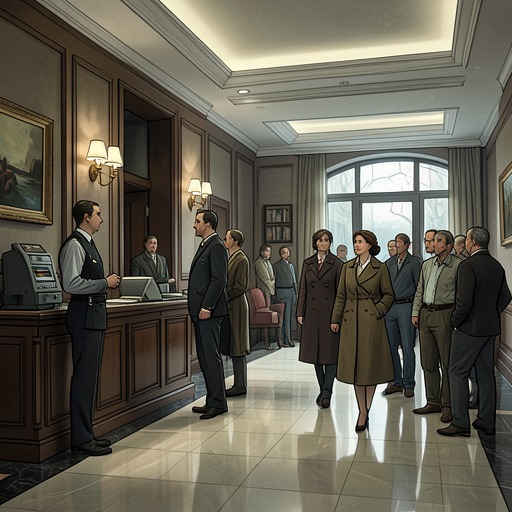
Bolsheviks
A Gentleman in MoscowThe Bolsheviks appear as a revolutionary movement turned governing power: they defeat the privileged classes, reshape public life, and mobilize the country for industrial and agricultural transformation. The novel’s portrait is deliberately double-edged. Revolutionary authority can threaten an opponent with execution or reorganize the food supply by force, yet pomp, hierarchy, and the impulse to classify people persist beneath the new political language.
From Revolution to Government
The Bolsheviks’ victory over the privileged classes is treated as decisive, but not as the end of political conflict. At Count Alexander Ilyich Rostov’s hearing, the committee weighs his testimony and his prerevolutionary poem, Where Is It Now? It judges that the poet who once expressed a clear-eyed revolutionary spirit has been corrupted by his class and now threatens the ideals he formerly espoused. The committee considers execution, but senior Party members regard Rostov as a hero of the prerevolutionary cause. It therefore orders his return to The Metropol, warning that he will be shot if he ever leaves again. The scene makes the new government’s power personal and immediate: political judgment determines not only how a man is classified, but where he may live and whether he may survive.
The committee’s decision also exposes a tension in the regime’s relationship to the past. Rostov’s aristocratic identity marks him as suspect, but his earlier opposition to the old order makes him useful to the new one. The committee does not simply erase his former political significance; it invokes that history to justify a sentence that confines him within the hotel. Revolution thus appears as both rupture and selection: the old class order is condemned, while individuals associated with its opponents may still be retained under strict control.
Political Assemblies and the Return of Pomp
During the summer, political gatherings become an increasingly familiar presence in the hotel. Small groups of men hurry through the lobby gesticulating and interrupting one another, then crowd together in the ballroom, many smoking as they argue. The gatherings take numerous forms—committees, caucuses, colloquiums, congresses, and conventions—and address codes, courses of action, complaints, and familiar problems recast in new terminology. Nina draws the Count to observe these Assemblies from the ballroom balcony. His reluctance comes less from political disagreement than from his dislike of political discourse, and from the physical discomfort of crouching unseen behind a narrow balustrade.
The narrative’s sharpest interpretation of revolutionary power concerns pomp. The Bolsheviks may abolish the Romanov-era autumn dances and diamond jubilees, but the novel imagines new banquets arising in their place, complete with guest lists, engraved invitations, formal service, and requests for more asparagus. Pomp, in this account, survives by adapting: it bows as an emperor is removed, then assists the new leader with his jacket, medals, chair, and ceremonial dinner. The passage does not claim that the old celebrations simply continue unchanged. Instead, it presents ceremony as a durable instrument of rank that can attach itself to a different regime and re-establish its influence around a new throne.
Class, Access, and Everyday Institutions
The transformation of the Boyarsky Restaurant provides a concrete measure of the new order’s effects on ordinary social life. Once renowned as one of Moscow’s finest restaurants, the Boyarsky had drawn hopeful diners who waited to catch the maître d’ Andrey’s attention and, if admitted, crossed the room amid formal greetings before being served at their table. In 1920, after the borders had been sealed, the Bolsheviks prohibited the use of rubles in fine restaurants. The restriction effectively closed such establishments to 99 percent of the population. The scene shifts accordingly: as the Count eats his entrée, water glasses and cutlery sound in an awkward room, couples whisper, and even the most accomplished waiters stare at the ceiling. A change in monetary rules has altered not just who can enter, but the atmosphere and purpose of the dining room.
The episode makes class politics tangible through access rather than abstract argument. A restaurant’s elegant service and exclusivity had depended on a social world that the revolution sought to overturn; the prohibition changes the terms on which that world can operate. Yet the novel’s broader treatment of pomp cautions against reading the change as a simple end to hierarchy. Old forms of distinction can be displaced while new ones gather around political authority.
Planning, Agriculture, and Coercion
The Bolshevik-led transformation of the economy is presented through the demands of the First Five-Year Plan. As urban comrades build power stations, steel mills, and heavy-machinery plants, the country’s grain-producing regions are expected to increase output to supply the cities. The account describes the exile of a million kulaks, characterized by the campaign as profiteers and enemies of the common good, while noting that they were also the regions’ most capable farmers. The contradiction is central: removing the people most able to farm is presented as part of a plan intended to raise agricultural production.
The practical obstacles compound one another. Peasants resent and distrust new agricultural methods and resist even small innovations; tractors, expected to usher in a new era, are scarce; and adverse weather contributes to collapsing output. Rather than reducing demands in response to the shortfall, the authorities increase grain quotas and requisitions, enforcing them at gunpoint to meet the imperative of feeding the cities. The narrative links this combination of forced displacement, resistance, inadequate equipment, poor conditions, and intensified extraction to widespread hardship in the agricultural provinces in 1932 and starvation deaths among millions of peasants in Ukraine. The planned transformation is therefore measured not only in industrial construction, but also in the human consequences of making local production answer to centralized targets.
Continuities of Bureaucratic Power
The novel repeatedly places political ambition beside systems that make people and resources administratively legible. In the agricultural campaign, the country’s needs are expressed as production targets, quotas, and requisitions; the stated purpose is national development and the feeding of the cities, but the narrative emphasizes how these measures collide with local conditions and scarce means. In another institutional setting, the Boyarsky’s staff are instructed to route orders through a waiter’s pad, a bookkeeper’s ledger, a kitchen log, cooking slips, and a stamped receipt before a dish may reach a table. That restaurant procedure is not identified as a Bolshevik policy, but its elaborate chain of records resonates with the broader novel’s attention to systems that replace individual judgment with formal entries and authorization.
The Bolsheviks’ wider significance in the novel lies in this unresolved combination of revolutionary change and institutional continuity. Their rule alters who may dine, who may assemble, how agriculture is organized, and what punishments the state can impose. At the same time, the narrative suggests that ceremony, hierarchy, and bureaucratic control are not automatically abolished with the old regime. They can return in new forms, serving new authorities and imposing costs that are visible in both the confined individual and the requisitioned countryside.